Vector Database Chunking Best Practices for RAG
Retrieval-Augmented Generation (RAG) pipelines live or die by the quality of their retrieval. The most powerful LLM in the world cannot answer a user’s question if the vector database retrieves the wrong document context.
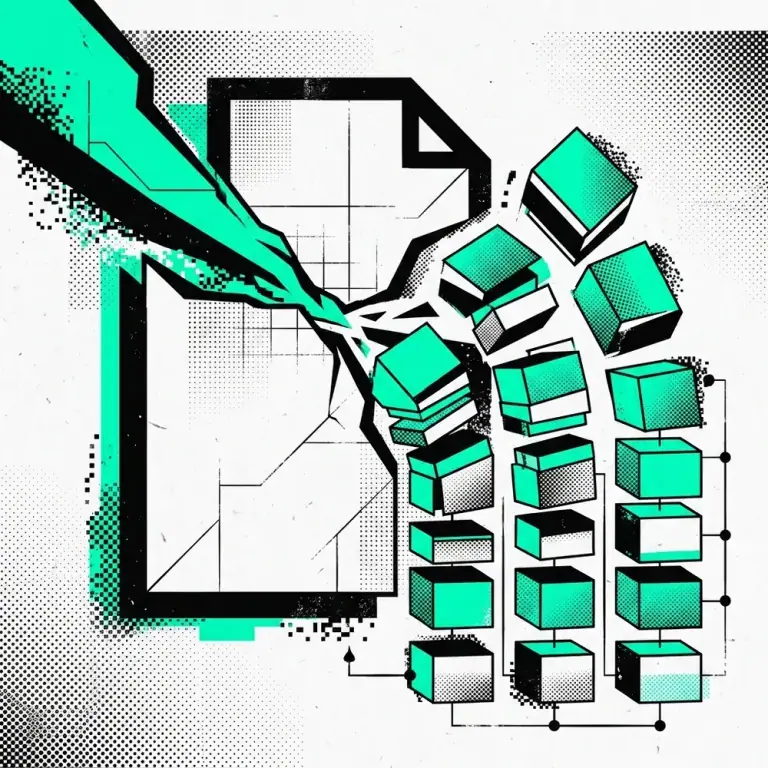
The most critical factor in retrieval quality is Chunking—the strategy you use to slice your source documents before embedding them. If your chunks are too large, the specific facts get lost in the noise. If your chunks are too small, the LLM loses the broader context needed to formulate a coherent answer.
In this guide, we explore the best practices for chunking documents for vector databases.
1. Move Beyond Fixed-Character Chunking
The most basic chunking strategy is to simply split a document every 1,000 characters.
Why it fails: Fixed-character chunking has zero awareness of sentence boundaries or semantic meaning. It will frequently slice a sentence or a word in half, destroying the contextual meaning of that specific chunk.
The Solution: Use Recursive Character Text Splitting. This method attempts to split the text using a hierarchy of separators (e.g., \n\n, then \n, then , then “). It tries to keep paragraphs together. If a paragraph is too large, it splits by sentences. This ensures that chunks remain semantically coherent.
2. Implement Strategic Chunk Overlap
When you split a document, you risk cutting a concept right in the middle. For example, Chunk A might introduce a complex problem, and Chunk B might provide the solution. If the user searches for the solution, Chunk B gets retrieved, but without Chunk A, the LLM lacks the context of the problem.
Best Practice: Implement a chunk overlap of 10% to 15%. If your chunk size is 500 tokens, set an overlap of 50 tokens. This ensures that the end of one chunk bleeds into the beginning of the next, preserving the continuity of thought across chunk boundaries.
3. Semantic Chunking (Advanced)
Recursive character splitting is better than fixed splitting, but it still relies on punctuation. Semantic Chunking uses a smaller, faster embedding model to evaluate the semantic similarity of adjacent sentences.
Instead of splitting based on length, it splits when the topic changes. If a speaker is talking about “API Pricing” for 800 tokens, it groups them. When the speaker shifts to “Latency,” it creates a new chunk.
This ensures that every single chunk in your vector database represents one cohesive, focused idea. This drastically improves the dot-product similarity scores during vector search.
4. The Parent-Child (Hierarchical) Indexing Pattern
A common dilemma in RAG:
- Small chunks (e.g., 200 tokens) are excellent for high-precision retrieval because their vector embeddings are highly focused.
- However, providing a 200-token chunk to the LLM often deprives it of the broader context needed to write a good answer.
The Solution: Decouple the “retrieved chunk” from the “context chunk” using a Parent-Child architecture.
- Split your document into large Parent Chunks (e.g., 1000 tokens).
- Split each Parent Chunk into multiple Child Chunks (e.g., 200 tokens each).
- Embed and store the Child Chunks in the vector database. Include a metadata reference to their Parent ID.
- During Search: Retrieve the top 3 most relevant Child Chunks.
- Before Generation: Look up the Parent IDs of those Child Chunks, fetch the full 1000-token Parent Chunks, and feed those to the LLM.
This gives you the best of both worlds: laser-focused retrieval accuracy and rich, comprehensive context for the LLM.
5. Metadata Tagging is Mandatory
Vectors alone are rarely enough for enterprise RAG. You must aggressively tag your chunks with metadata before inserting them into the database.
Always append:
document_idandsource_urlcreation_dateandlast_updatedauthorordepartmentcategory(e.g., “HR Policy”, “Technical Docs”)
By adding metadata, you can perform Pre-filtering on your vector searches. If a user asks a question about the “2024 Q3 Earnings,” you can add a metadata filter date >= 2024-07-01 to the query. This prevents the vector database from even considering older, irrelevant chunks, drastically improving accuracy and reducing hallucination.
(Tip: You can use our Embedding Inspector tool to visualize how your chosen embedding model maps different chunk sizes into vector space).
Conclusion
Effective chunking is an iterative process. You must analyze your user queries and adjust your chunk sizes, overlap ratios, and retrieval strategies accordingly. Start with recursive character splitting and a 10% overlap, and as your pipeline matures, graduate to semantic chunking and hierarchical indexing for state-of-the-art RAG performance.