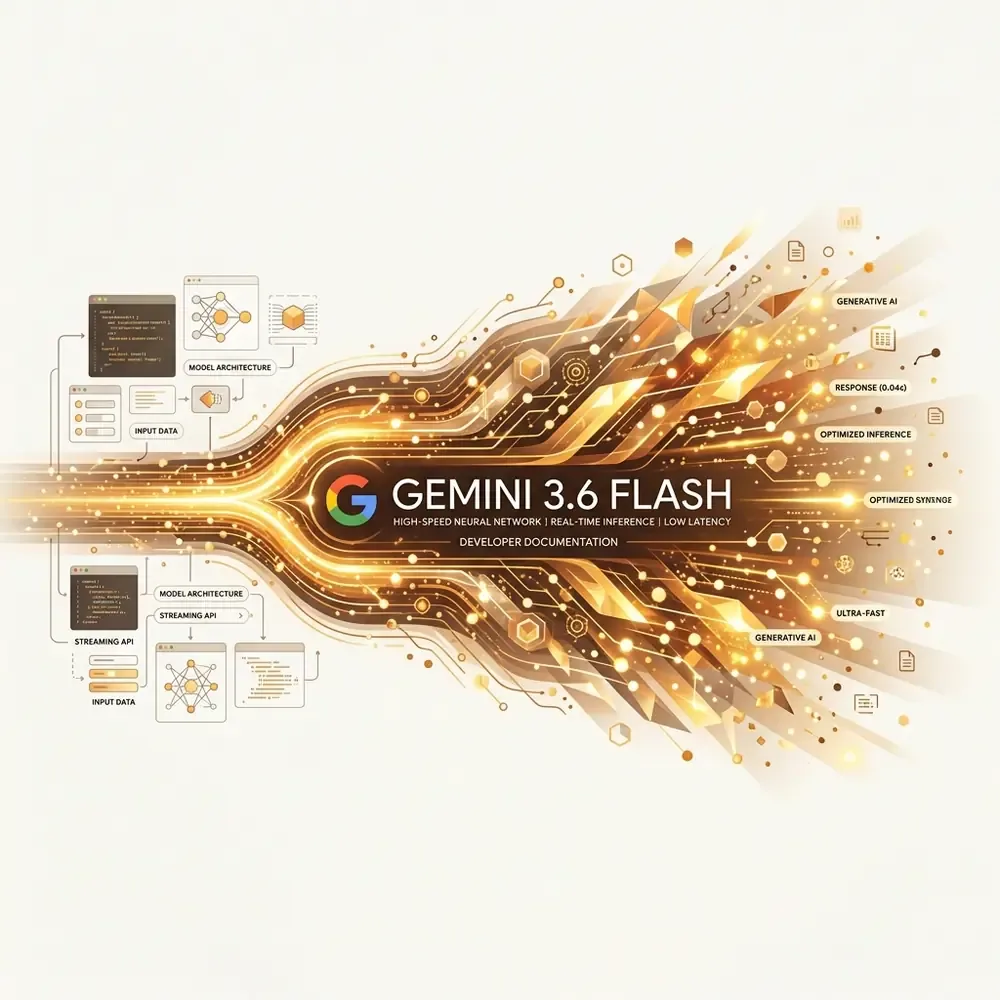
Google released Gemini 3.6 Flash on July 21, 2026, positioning it as the definitive workhorse model in the Gemini 3 series. Built for developers who need fast, precise, and cost-effective AI across coding, knowledge work, and complex multimodal tasks, 3.6 Flash replaces 3.5 Flash as the default recommended model for production agentic workloads.
This guide provides a thorough analysis of the model’s architecture improvements, benchmark performance, developer integration pathways, pricing structure, and practical implementation patterns.
What Makes Gemini 3.6 Flash Different
Gemini 3.6 Flash is not a generational leap — it is a surgical optimization of the 3.5 Flash architecture designed to reduce waste while increasing accuracy in the scenarios that matter most to professional developers.
Core Improvements Over 3.5 Flash
| Metric | Gemini 3.5 Flash | Gemini 3.6 Flash | Improvement |
|---|---|---|---|
| Output Token Efficiency | Baseline | −17% tokens | Fewer tokens for equivalent quality |
| Reasoning Steps (Multi-Step) | Baseline | Fewer steps | Reduced tool call chains |
| Code Generation Precision | Good | Higher precision | Fewer unwanted edits and loops |
| Knowledge Cutoff | Dec 2025 | March 2026 | 3 months fresher |
| Agentic Task Completion | Good | Improved | Better long-horizon task handling |
The efficiency gains are not just about speed — they directly reduce API costs. If your application makes thousands of completions per day, a 17% reduction in output tokens translates to meaningful savings at scale.
Architecture and Design Philosophy
Gemini 3.6 Flash was designed for what Google calls the agentic era — applications where models operate semi-autonomously, chaining tool calls, processing long contexts, and maintaining coherent state across multi-step workflows.
Key Architectural Decisions
Parallel Tool Use: The model natively supports issuing multiple tool calls in a single generation step. This eliminates the serial bottleneck where previous Flash models would call one tool, wait for a result, then call the next.
graph LR
    A[User Query] --> B[Gemini 3.6 Flash]
    B --> C[Tool Call 1: Search API]
    B --> D[Tool Call 2: Code Exec]
    B --> E[Tool Call 3: File Read]
    C --> F[Aggregate Results]
    D --> F
    E --> F
    F --> G[Final Response]
Reduced Reasoning Loops: In benchmark testing, 3.6 Flash completes complex agentic tasks with fewer intermediate reasoning steps. This means fewer API round-trips, lower latency, and reduced token consumption.
Improved Code Generation: The model produces more surgically precise code edits — targeting only the lines that need to change rather than regenerating entire functions or files. This is particularly valuable in agentic coding tools like GitHub Copilot and Cursor.
Benchmark Performance
Gemini 3.6 Flash posts significant improvements on the benchmarks that matter most for real-world developer workflows:
DeepSWE (Agentic Software Engineering)
DeepSWE evaluates a model’s ability to navigate codebases, understand issue descriptions, and produce working patches — the kind of task that agentic coding tools perform daily. Gemini 3.6 Flash shows a measurable jump in accuracy while using fewer tool calls per resolution.
MLE Bench (Machine Learning Engineering)
MLE Bench tests a model’s ability to design, implement, and debug machine learning pipelines. 3.6 Flash demonstrates improved performance in experiment design and hyperparameter reasoning.
Practical Implications
For developers using Gemini 3.6 Flash via API or through tools like GitHub Copilot, these benchmark improvements translate to:
- Fewer failed code generation attempts that require re-prompting
- More accurate multi-file edits in complex repositories
- Better understanding of project context across long conversations
- Reduced API costs due to fewer tokens and fewer round-trips
Pricing and Cost Analysis
Google has positioned Gemini 3.6 Flash as one of the most cost-effective frontier models available:
| Model | Input (per 1M tokens) | Output (per 1M tokens) | Context Window |
|---|---|---|---|
| Gemini 3.6 Flash | $1.50 | $7.50 | 1M tokens |
| Gemini 3.5 Flash | $1.25 | $5.00 | 1M tokens |
| GPT-4.1 | $2.00 | $8.00 | 1M tokens |
| Claude Sonnet 4 | $3.00 | $15.00 | 200K tokens |
While the per-token price is slightly higher than 3.5 Flash, the 17% reduction in output tokens means the effective cost per task is often lower. For applications that generate high volumes of output — code generation, document summarization, agentic workflows — the total spend typically decreases.
Cost Optimization Tips
- Use structured output schemas to prevent the model from generating verbose explanations when you only need JSON.
- Enable parallel tool use to reduce the number of API round-trips in agentic chains.
- Set appropriate
max_tokenslimits to prevent runaway generation on open-ended prompts. - Cache system prompts using Google’s context caching feature to reduce input token costs on repeated calls.
Getting Started with the API
Prerequisites
- A Google Cloud account or Google AI Studio API key
- Node.js 18+ or Python 3.10+
JavaScript / TypeScript Setup
import { GoogleGenAI } from "@google/genai";

const ai = new GoogleGenAI({ apiKey: process.env.GEMINI_API_KEY });

async function generateCode(prompt) {
  const response = await ai.models.generateContent({
    model: "gemini-3.6-flash",
    contents: prompt,
    config: {
      temperature: 0.2,
      maxOutputTokens: 4096,
      responseMimeType: "application/json",
    },
  });

  return response.text;
}

// Example: Generate a React component
const result = await generateCode(
  "Create a responsive pricing card component in React with Tailwind CSS"
);
console.log(result);
Python Setup
import google.generativeai as genai

genai.configure(api_key="YOUR_API_KEY")

model = genai.GenerativeModel("gemini-3.6-flash")

response = model.generate_content(
    "Explain the difference between async/await and Promises in JavaScript",
    generation_config=genai.GenerationConfig(
        temperature=0.3,
        max_output_tokens=2048,
    ),
)

print(response.text)
Using with Google AI Studio
For rapid prototyping, Google AI Studio provides a browser-based interface where you can:
- Select Gemini 3.6 Flash from the model dropdown
- Configure temperature, top-k, top-p, and safety settings
- Test prompts with real-time streaming
- Export your configuration as API code in Python, JavaScript, or cURL
GitHub Copilot Integration
Gemini 3.6 Flash is available as a model option in GitHub Copilot for Pro, Business, and Enterprise subscribers.
How to Enable
- Open your IDE (VS Code, JetBrains, or Neovim)
- Open the Copilot Chat panel
- Click the model selector dropdown
- Choose Gemini 3.6 Flash from the list
- Start coding — completions will now be powered by Gemini 3.6 Flash
When to Use Gemini 3.6 Flash in Copilot
- Multi-file refactoring tasks where you need the model to understand cross-file dependencies
- Agentic coding sessions where Copilot needs to search, read, and edit multiple files
- Complex debugging where the model needs to reason through stack traces and log outputs
- Large context windows — Gemini 3.6 Flash supports up to 1M tokens, far exceeding most competitors
Best Practices for Production
1. System Prompt Engineering
Keep system prompts focused and structured. Gemini 3.6 Flash responds well to clear role definitions and output format specifications:
You are a senior backend engineer. Generate production-ready code only.
Follow these rules:
- Use TypeScript with strict types
- Include error handling for all async operations
- Add JSDoc comments for public functions
- Return JSON responses with consistent error formatting
2. Structured Output Mode
Use responseMimeType: "application/json" with a JSON schema to get deterministic, parseable output:
const response = await ai.models.generateContent({
  model: "gemini-3.6-flash",
  contents: "Analyze this error log and identify the root cause",
  config: {
    responseMimeType: "application/json",
    responseSchema: {
      type: "object",
      properties: {
        rootCause: { type: "string" },
        severity: { type: "string", enum: ["low", "medium", "high", "critical"] },
        suggestedFix: { type: "string" },
        affectedFiles: { type: "array", items: { type: "string" } },
      },
    },
  },
});
3. Context Caching for Repeated Workflows
If your application sends the same system prompt or reference documents with every request, use Google’s context caching to store them server-side. This can reduce input token costs by up to 90% for cached content.
4. Safety and Guardrails
Configure safety settings appropriate for your use case. For developer tools, you may want to relax code-related safety filters while keeping other categories strict:
config: {
  safetySettings: [
    { category: "HARM_CATEGORY_DANGEROUS_CONTENT", threshold: "BLOCK_ONLY_HIGH" },
  ],
}
Gemini 3.6 Flash vs Competitors
For Coding Tasks
Gemini 3.6 Flash excels at multi-step agentic coding — tasks where the model needs to search a codebase, understand context, and produce precise edits. Its parallel tool use capability gives it a significant speed advantage over models that process tool calls serially.
For Cost-Sensitive Applications
At $1.50/$7.50 per million tokens with 17% fewer output tokens, Gemini 3.6 Flash is among the most cost-effective frontier models for high-volume applications.
For Context-Heavy Workflows
With a 1M token context window, Gemini 3.6 Flash can ingest entire codebases, documentation sets, or conversation histories without truncation — a significant advantage over models limited to 128K or 200K tokens.
Key Takeaways
- Gemini 3.6 Flash is Google’s latest optimized workhorse model, released July 21, 2026
- It consumes 17% fewer output tokens than 3.5 Flash for equivalent tasks
- Pricing is $1.50 input / $7.50 output per million tokens with a 1M token context window
- Available via Gemini API, Vertex AI, Google AI Studio, and GitHub Copilot
- Built for the agentic era with parallel tool use, improved code precision, and reduced reasoning loops
- Knowledge cutoff is March 2026, providing fresher world knowledge than most competitors
What’s Next
Google has signaled that Gemini 3.6 Flash is the foundation for upcoming specialized variants. The simultaneously announced Gemini 3.5 Flash-Lite targets high-throughput, low-latency batch processing, while Gemini 3.5 Flash Cyber is a purpose-built cybersecurity model available to select enterprise partners.
For developers building agentic applications, Gemini 3.6 Flash represents the current sweet spot of capability, speed, and cost — making it the recommended starting point for new projects in the Gemini ecosystem.