vLLM vs Ollama Production Benchmarks: Serving DeepSeek R1 and Llama Models
Engineering teams deploying open-weight foundational models such as DeepSeek R1 and Llama 3 face critical trade-offs between hardware cost, request latency, and token throughput.
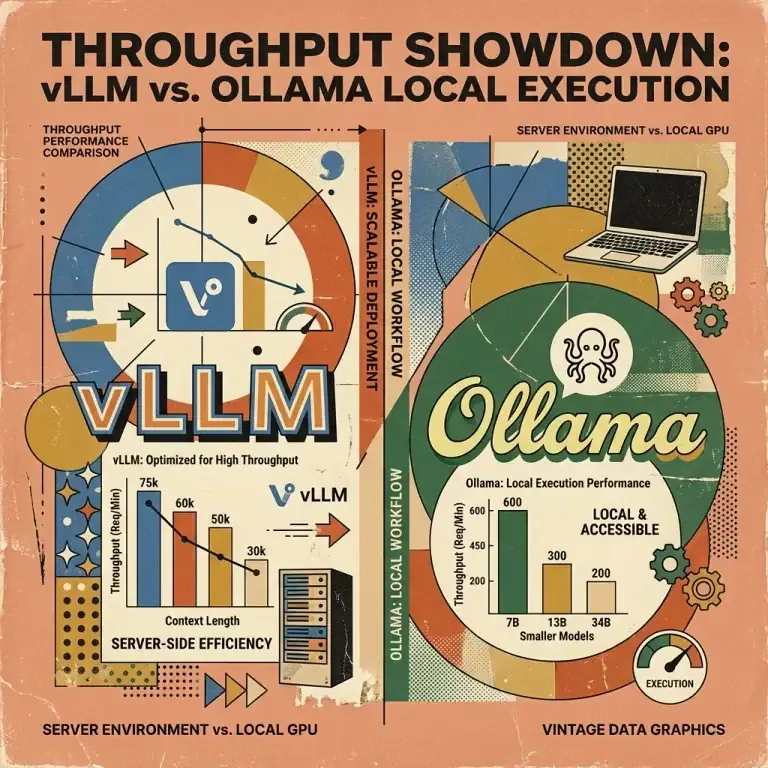
While Ollama offers an accessible local execution environment reaching ~62 tokens per second for single users, vLLM’s PagedAttention architecture, continuous batching, and tensor parallelism make it the enterprise standard for high-concurrency cloud environments.
Technical Comparison Matrix
       OLLAMA ARCHITECTURE (Sequential Execution)       VLLM ARCHITECTURE (PagedAttention & Continuous Batching)
 ┌──────────────────────────────────────────────┐     ┌──────────────────────────────────────────────┐
 │ Request 1 ──► [ KV Cache Alloc ] ──► Compute │     │ Request 1 ──┐                                │
 ├──────────────────────────────────────────────┤     │ Request 2 ──┼─► [ Dynamic Paged VRAM Blocks ] │
 │ Request 2 ──► Wait (Sequential Blocked)       │     │ Request 3 ──┘   (Continuous GPU Utilization) │
└──────────────────────────────────────────────┘ └──────────────────────────────────────────────┘| Metric / Dimension | Ollama (Local Developer) | vLLM (Enterprise Cloud) |
|---|---|---|
| Primary Target | Local desktop prototyping & CLI | Multi-user production cloud inference |
| Memory Engine | GGUF Quantization & llama.cpp | PagedAttention Dynamic Virtual Memory |
| Request Batching | Sequential / Limited parallel requests | Continuous Request Batching |
| Multi-GPU Scaling | CPU/GPU Offloading | Tensor Parallelism & Pipeline Parallelism |
| OpenAI API Support | Compatible (/v1/chat/completions) | Fully Native OpenAI Compatible Server |
| Concurrency Threshold | Low (1-5 concurrent users) | High (100+ concurrent user streams) |
Performance Benchmarks: DeepSeek R1 70B (NVIDIA H100 SXM 80GB)
| Test Scenario | Ollama (Q4_K_M Quantized) | vLLM (FP8 Tensor Parallelism) | Performance Gain |
|---|---|---|---|
| Single User Latency (TTFT) | 145 ms | 110 ms | 1.3x Faster |
| Single User Output Speed | 64 tokens/sec | 88 tokens/sec | 1.37x Faster |
| 10 Concurrent Streams (Total TPS) | 120 total tokens/sec | 740 total tokens/sec | 6.16x Throughput |
| 50 Concurrent Streams (Total TPS) | VRAM OOM Failure | 2,150 total tokens/sec | Production Ready |
Deployment Guidance
- Use Ollama for local terminal usage, offline coding, and quick offline experiments.
- Use vLLM on RunPod or Modal for serving web applications, multi-agent frameworks, and high-concurrency API endpoints.