Claude Fable 5 AI Model Review: A New Challenger in Reasoning and Coding
Anthropic’s release of Claude Fable 5 has introduced a powerful alternative to standard enterprise models. Designed for complex reasoning and large-scale document parsing, this review examines the capabilities, deployment viability, and safety architecture of Claude Fable 5.
Context Capacity and Performance
Fable 5 represents a major milestone in high-context LLMs. With a native 1 million token context window, developers can feed entire code repositories directly to the prompt context. Additionally, it supports up to 128k output tokens in a single execution step, enabling it to write extensive codebase refactoring scripts without needing separate chunking workflows.
Pros & Cons
Pros
- Context Retention: Fable 5 maintains high recall rates even at the limits of its 1 million token context window.
- Architecture Design: The model excels at identifying design flaws and generating comprehensive, multi-file refactoring scripts.
- Deep Output Token Bounds: Up to 128k output tokens per request enables large file generations.
Cons
- Premium Pricing: At $10.00/1M Input and $50.00/1M Output, it is a premium tool and can generate high bills during recurrent loops.
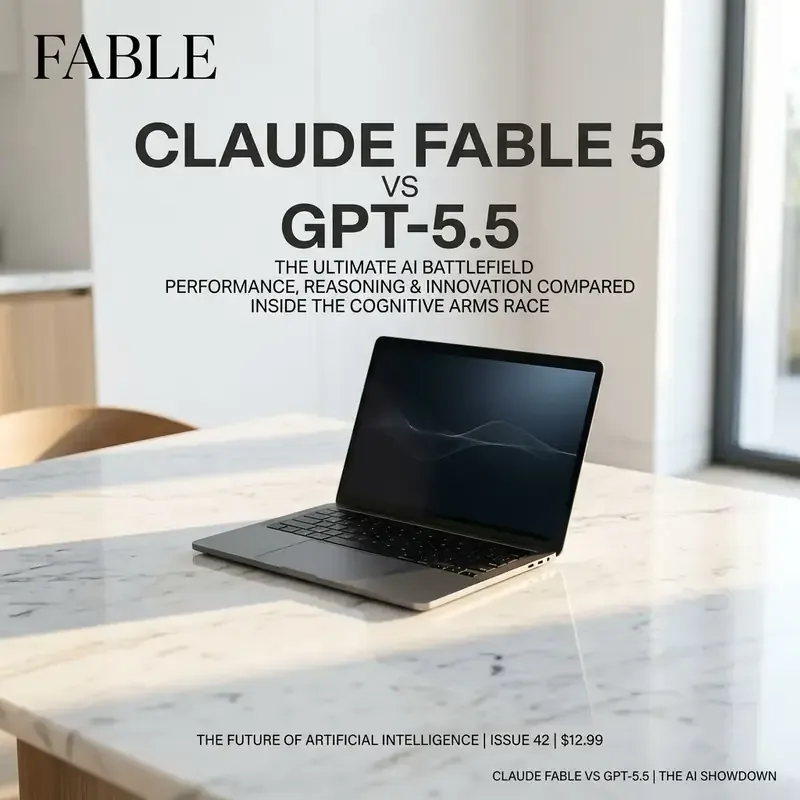
- Speed: Latency is higher than GPT-5.5, making it less suitable for quick chat operations.
- Classifiers: Safety layers can decline cybersecurity analysis or biology research tasks.
The Claude Mythos 5 Connection
Claude Fable 5 is closely related to Claude Mythos 5, which shares the same underlying capabilities but operates without the safety classifiers. Mythos 5 is limited to a select group of partners through programs like Project Glasswing, while Fable 5 is widely available.
Additionally, Fable 5 was briefly suspended in mid-June 2026 due to U.S. government export controls regarding foreign access. Access was restored on July 1, 2026, following compliance upgrades.
Image Metadata
- Hero Image:
- Prompt: “Elegant glass emblem featuring a subtle ‘F’ logo, floating in a clean white studio room with soft daylight and shadow patterns”
- Filename: “fable-5-review.jpg”
- Alt: “Glassmorphic logo emblem review”
- Supporting Visual 1:
- Prompt: “Pros and cons list styled as elegant typography on a minimalist white poster layout, soft grey background”
- Filename: “pros-cons-list.jpg”
- Alt: “Pros and cons listing poster”
- Supporting Visual 2:
- Prompt: “Close-up of a high-end metal mechanical pencil and sketchpad resting on a sleek white workspace desk”
- Filename: “workspace-sketchpad.jpg”
- Alt: “Drawing workstation mockup”
Frontier LLM Benchmark & Developer Guides
- Explore Anthropic’s autonomous terminal execution loop in Inside Claude Code Agent: Terminal Loop Architecture.
- For official Anthropic credentials and Pearson VUE exams, read Anthropic Claude Certification Guide: Exams & Credentials.
- Compare Claude Fable 5 against OpenAI flagships in Claude Fable 5 vs GPT-5.5: Detailed Benchmarks.
- Compare open weights vs proprietary models in Kimi K3 vs Claude Fable 5 vs GPT-5.6 Soul.