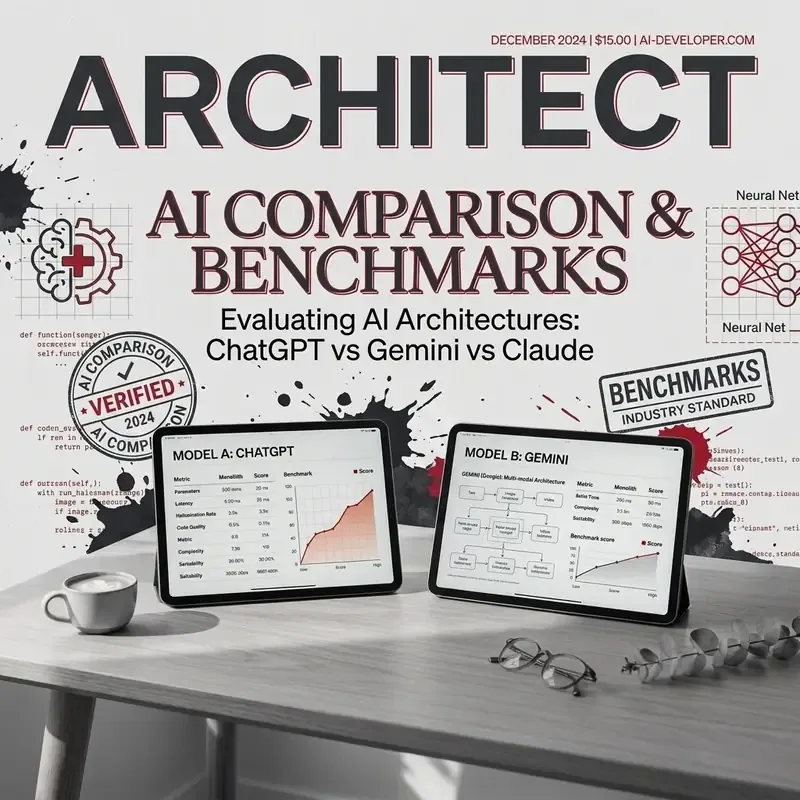
The AI assistant landscape in 2026 is a three-way race between OpenAI’s ChatGPT, Google’s Gemini, and Anthropic’s Claude. Each platform has carved out distinct strengths while rapidly closing gaps in areas where competitors lead.
This comparison cuts through the marketing to deliver a practical, benchmark-backed analysis of where each model excels, where it falls short, and which one deserves your attention based on your specific needs.
Executive Summary
| Dimension | ChatGPT (GPT-5.x) | Gemini (3.6 Flash) | Claude (Sonnet 4) |
|---|---|---|---|
| Coding | ★★★★☆ | ★★★★★ | ★★★★★ |
| Reasoning | ★★★★★ | ★★★★☆ | ★★★★★ |
| Creative Writing | ★★★★☆ | ★★★☆☆ | ★★★★★ |
| Multimodal | ★★★★☆ | ★★★★★ | ★★★☆☆ |
| Context Window | 1M tokens | 1M tokens | 200K tokens |
| Cost (per 1M output) | $8.00 | $7.50 | $15.00 |
| Speed | Fast | Fastest | Moderate |
| Safety | Good | Good | Best-in-class |
| Plugin Ecosystem | Largest | Growing | Limited |
Bottom line: Choose ChatGPT for the broadest ecosystem and general-purpose tasks. Choose Gemini for multimodal work, cost efficiency, and agentic coding. Choose Claude for writing quality, safety-critical applications, and long-form analysis.
Coding Performance
The 2026 Coding Landscape
Coding is the highest-value use case for AI models, and all three competitors have invested heavily in this domain.
Gemini 3.6 Flash leads in agentic coding scenarios — tasks where the model needs to search across codebases, execute parallel tool calls, and produce precise multi-file edits. Its 17% token efficiency improvement and parallel tool use capability give it a measurable edge in automated coding workflows (IDE agents, CI/CD integration, automated refactoring).
Claude Sonnet 4 produces the most human-readable code. Its outputs tend to include better variable naming, more contextual inline comments, and a coding style that feels more natural to review. For pair programming and code review assistance, Claude is often preferred by senior developers.
ChatGPT (GPT-5.x) offers the most mature plugin and integration ecosystem. With GPTs, custom instructions, and a vast marketplace of coding-specific extensions, ChatGPT is the most customizable platform for developer workflows.
Benchmark Comparison
| Benchmark | ChatGPT | Gemini 3.6 Flash | Claude Sonnet 4 |
|---|---|---|---|
| SWE-bench Verified | Strong | Strong | Strong |
| DeepSWE (Agentic) | Good | Best | Good |
| HumanEval+ | Strong | Strong | Strong |
| MLE Bench | Good | Best | Strong |
| Multi-file Refactoring | Good | Best | Strong |
Verdict: Gemini 3.6 Flash for automated/agentic coding. Claude for pair programming and code review. ChatGPT for ecosystem breadth.
Reasoning and Analysis
Complex Problem Solving
All three models have achieved strong reasoning capabilities, but they approach problems differently:
ChatGPT (GPT-5.x) uses chain-of-thought reasoning with a transparent thinking process. Its o-series models (o3, o4-mini) are specifically optimized for deep reasoning tasks, mathematical proofs, and multi-step logic problems.
Gemini 3.6 Flash is optimized for efficient reasoning — solving problems in fewer steps with less token waste. This makes it ideal for applications where reasoning needs to happen at scale (batch processing, automated analysis pipelines).
Claude Sonnet 4 excels at nuanced analysis where the answer is not clear-cut. It is particularly strong at identifying edge cases, acknowledging uncertainty, and presenting balanced perspectives on complex topics.
When Each Model Wins
- Mathematical proofs and formal logic: ChatGPT (o3/o4-mini)
- Efficient, scaled reasoning: Gemini 3.6 Flash
- Nuanced analysis with uncertainty: Claude Sonnet 4
Multimodal Capabilities
This is where the three platforms diverge most dramatically.
Google Gemini: The Multimodal Leader
Gemini has the most comprehensive multimodal generation and understanding suite:
- Image generation: Imagen 4 (native in Gemini App)
- Video generation: Gemini Omni and Omni Flash (3-10 second clips, conversational editing)
- Music generation: Lyria 3 (30-second stereo tracks with vocals)
- Image understanding: Best-in-class visual analysis
- Document understanding: PDF, slides, and handwritten text
- Audio understanding: Speech, music, and environmental sounds
ChatGPT: Strong but Narrower
- Image generation: DALL-E 4 (high quality, mature)
- Video generation: Limited (Sora integration still restricted)
- Image understanding: Excellent
- Document understanding: Good
- Audio: Voice mode with real-time conversation
Claude: Analysis-Focused
- Image generation: None (no native image generation)
- Video generation: None
- Image understanding: Very strong (analysis and description)
- Document understanding: Excellent (especially for long PDF analysis)
- Audio: Limited
Verdict: Gemini dominates multimodal creation. ChatGPT is strong for image generation. Claude wins at multimodal analysis and understanding, particularly for document-heavy workflows.
Context Window and Memory
| Model | Context Window | Effective Long-Context Quality |
|---|---|---|
| ChatGPT (GPT-4.1) | 1M tokens | Good |
| Gemini 3.6 Flash | 1M tokens | Excellent |
| Claude Sonnet 4 | 200K tokens | Excellent (within window) |
Gemini and ChatGPT both offer 1M token context windows, but Gemini’s long-context performance is widely considered more reliable — it maintains higher accuracy when retrieving information from deep within large contexts (the “needle in a haystack” test).
Claude’s 200K token limit is smaller, but within that window, its comprehension quality is exceptional. Anthropic has prioritized depth of understanding over raw context size.
Practical Implications
- Ingesting an entire codebase: Gemini or ChatGPT (1M tokens)
- Analyzing a 200-page legal document: All three are capable, but Claude’s comprehension quality edges out
- Processing a conversation spanning days: Gemini handles the longest conversations without degradation
Pricing Deep Dive
API Pricing (Per 1M Tokens)
| Model | Input Cost | Output Cost | Context Caching |
|---|---|---|---|
| GPT-4.1 | $2.00 | $8.00 | Available |
| GPT-4.1 mini | $0.40 | $1.60 | Available |
| Gemini 3.6 Flash | $1.50 | $7.50 | Available |
| Gemini 3.5 Flash-Lite | $0.25 | $1.00 | Available |
| Claude Sonnet 4 | $3.00 | $15.00 | Available |
| Claude Haiku 3.5 | $0.80 | $4.00 | Available |
Consumer Subscription Pricing
| Plan | ChatGPT | Gemini | Claude |
|---|---|---|---|
| Free tier | ✅ (Limited) | ✅ (Limited) | ✅ (Limited) |
| Pro/Standard | $20/mo | $20/mo (AI Pro) | $20/mo (Pro) |
| Premium/Ultra | $200/mo (Pro) | $250/mo (AI Ultra) | $200/mo (Max) |
Cost Efficiency Analysis
For high-volume developer workflows, Gemini 3.6 Flash offers the best cost-per-quality ratio. Its 17% token efficiency improvement means the effective cost is often lower than the nominal pricing suggests. For budget-constrained projects, Gemini 3.5 Flash-Lite at $0.25/$1.00 is unmatched.
Safety and Alignment
Anthropic Claude: Safety Leader
Claude is built on Anthropic’s Constitutional AI framework, making it the most safety-conscious of the three models. It is more likely to refuse harmful requests, acknowledge its limitations, and provide balanced perspectives on controversial topics.
OpenAI ChatGPT: Balanced Approach
ChatGPT strikes a balance between capability and safety, with configurable safety settings for enterprise deployments and transparent content policies.
Google Gemini: Enterprise-Grade Controls
Gemini offers granular safety settings through the API, allowing developers to tune sensitivity levels per harm category. Enterprise deployments through Vertex AI include additional data governance and compliance features.
Verdict: Claude for safety-critical applications (healthcare, legal, education). Gemini for enterprise compliance. ChatGPT for the broadest community standards.
Platform Ecosystem
ChatGPT Advantages
- GPT Store: Thousands of custom GPTs for specialized tasks
- Plugin ecosystem: Largest marketplace of third-party integrations
- Custom GPTs: Build and share custom AI assistants without code
- Enterprise features: Team workspaces, admin dashboards, SSO
Gemini Advantages
- Google Workspace integration: Native in Gmail, Docs, Sheets, Slides, Meet
- Google Search grounding: Real-time web access with citation
- Gemini Spark: Proactive agentic assistant that works in the background
- Gemini Notebook: Dedicated research workstation with code execution
- GitHub Copilot: Direct integration for coding workflows
Claude Advantages
- Artifacts: Interactive code previews and document generation inline
- Projects: Organized workspaces with persistent context and knowledge bases
- MCP (Model Context Protocol): Open standard for tool integration
- Team collaboration: Shared conversations and knowledge across organizations
Recommendation Matrix
| If You Need… | Choose |
|---|---|
| Best overall multimodal creation | Gemini |
| Cheapest high-quality API | Gemini 3.6 Flash |
| Longest effective context window | Gemini |
| Best creative writing quality | Claude |
| Most mature plugin ecosystem | ChatGPT |
| Safety-critical applications | Claude |
| Google Workspace integration | Gemini |
| Custom AI assistants (no-code) | ChatGPT |
| Pair programming and code review | Claude |
| Agentic coding workflows | Gemini |
| Deep reasoning (math/logic) | ChatGPT (o3) |
| Enterprise compliance | Gemini (Vertex AI) |
Key Takeaways
- There is no single best AI — the right choice depends on your specific use case and workflow
- Gemini 3.6 Flash leads in multimodal capabilities, cost efficiency, and agentic coding
- Claude Sonnet 4 excels at writing quality, nuanced analysis, and safety
- ChatGPT (GPT-5.x) offers the broadest ecosystem and strongest deep reasoning
- For most developers, trying all three with their free tiers is the best way to find your preference
- API pricing favors Gemini for high-volume production workloads